All posts by coleswildbird

How Do You Tell a House Finch From a Purple Finch?

Many people mistake a House Finch for a Purple Finch. It can be tough to tell them apart. They are about the same size and shape, but the difference is in the coloring. The males can be distinguished by the shades of color. The male House Finch is an reddish-orange, while the male Purple Finch is a reddish-purple.

  • Male House Finch Male House Finch
  • Male Purple Finch Male Purple Finch
  • Female House Finch
  • Female Purple Finch

  The House Finch has what looks like streaking on the breast and the sides. The Purple Finch has stripes but not streaking. The Purple Finch looks as if it someone poured purple dye on its head and the color moved over the original brown and cream and flowed down the back and down the chest. The House Finch has color along its eyebrow, but the entire head does not have color. The House Finch also has color on its chest. You’ll have a tougher time trying to tell the female House Finch and Purple Finch apart. Both are various shades of brown and white with no distinguishing colors. The female Purple Finch has bold facial patterns. She has a distinctive white streak over her eye, a dark cheek patch, and a white stripe at the bottom of the cheek. The female House Finch looks mostly brown but has some white feathers showing through on her sides and back. The female Purple Finch has what looks like white and brown streaks down the breast and dark brown coloring on her back. Both the House Finch and the Purple Finch love to eat sunflower seeds and sunflower meats and will often visit feeders to get them. You’ll see House Finches all over the eastern part of the United States. Purple Finches live in the north and breed in southeast Canada. Now, that you can spot the differences, you’ll enjoy watching for House Finches and Purple Finches at the feeder!
The Northern Flicker is Cole’s Wild Bird Products Bird of the Month

Northern Flicker is actually the name for several subspecies of medium sized woodpeckers which include the Yellow-shafted Flicker, Red-shafted Flicker, Gilded Flicker, Guatemalan Flicker, and the Cuban Flicker.

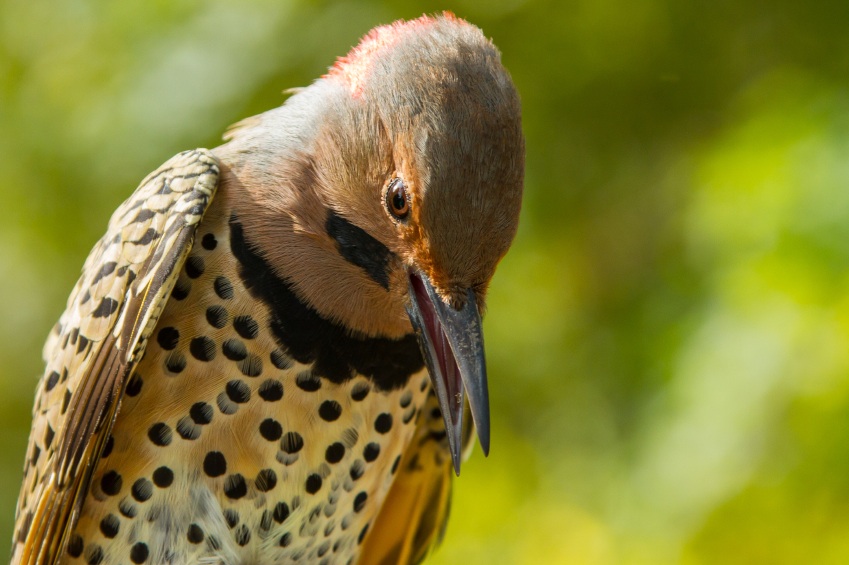
They are beautiful birds with striking markings. The males and females are grayish brown with horizontal barring across the back and wings. The tail is white with brownish black bars and solid black tips while the breast is light brown to off-white and has blackish brown spots. The best way to spot the males is to look for a stripe that may be bright red or black that starts at the beak and looks like a mustache down the side of the neck.

Northern Flickers live all across the North American continent as well as Central America and in Cuba. If you live west of the Rocky Mountains, you’ll see the Red-Shafted, east of the Rocky Mountains, you’ll find the Yellow-Shafted, and if you live in the Southwest, you’ll see the Gilded.

Although Northern Flickers have adapted well to living around humans, making their homes in urban areas, the suburbs, the edge of forests, parks, meadows and farms, they’ve struggled over the past 20 years. Sadly, the population is declining because of intense competition with European Starlings for nest sites combined with the removal of prime nesting trees every time land for a new subdivision or commercial center is cleared.

Northern Flickers tend to be picky nesters preferring to nest and excavate in a tree of their choosing, but when a good tree is not available they will use posts and birdhouses, or even re-use and repair damaged and abandoned nests.

Northern Flickers are the most terrestrial of all North American woodpeckers and can usually be found on the ground hopping along looking for ants. These birds love to eat ants. They eat more ants than any other bird species in North America with ants alone making up 45% of their diet. The other 55% is comprised of flies, butterflies, moths, beetles and snails with some fruits, berries, seeds, and nuts thrown in to round things out. Occasionally, they will visit a feeder, but that is not very common.

Northern Flickers return to their breeding ground in March and April. A few weeks after returning, courtships begin. By late April to early May, pairs have bonded and begin to breed. They are monogamous for life, but if a bird loses its mate due to death or disappearance, it will find a replacement.

Both the male and female aggressively defend a territory, which consists of the prospective nest site and its immediate surroundings. Vocalizations and “drumming” are used to define and defend territory boundaries. This bird’s call is a sustained laugh, “ki ki ki ki “and is easy to identify when heard. Since the drumming is about territory defense, they like it to be as loud as possible. That’s why woodpeckers sometimes drum on metal objects. One Northern Flicker in Wyoming could be heard drumming on an abandoned tractor a half-mile away. Once incubation begins, however, the pair spends less time defending their territory and will even allow other pairs to move into the vicinity and nest nearby.

Northern Flickers are adaptable, beautiful birds with an upbeat call and a big appetite for ants. If you see one or have photos of one, please share them on the Cole’s Wild Bird Products Facebook page.

https://www.facebook.com/pages/Coles-Wild-Bird-Products-Company/125017247634656?fref=ts


Fact or Fiction: Feeding Wild Birds Makes Them Lazy

It’s fiction. Despite years of research that can find no evidence of any harm from feeding wild birds and studies showing birds use feeders for only about 25% of their diet, the myth that feeding wild birds will make them too lazy to find food still persists. According to the Humane Society of the United States, experts still disagree about whether feeding backyard birds will increase bird populations overall; however, they say feeding birds can certainly help the birds in your neighborhood. In fact, the Humane Society encourages people to feed wild birds, especially in the winter. Below is advice from the Humane Society of the United States website about placing feeders.

Birds are most likely to eat where they feel safe from predators, including free roaming cats. Place feeders twelve feet from a brush pile, evergreen tree, or bush. Birds can quickly fly twelve feet to reach the safe cover, yet predators cannot use it to hide within striking range of the feeder. As further protection, place chicken wire or thorny branches around ground-level feeders. 

Five Benefits of Landscaping To Attract Birds

Making your yard bird-friendly offers so many benefits. From hours of bird watching enjoyment to the practical benefits of natural insect control, you have so many reasons to create a little backyard paradise for your feathered friends.

Increased Songbird Visits
According to the U. S. Fish and Wildlife Service, you can double the number of bird species visiting your yard if you have a bird-friendly landscaping plan. Many plants and shrubs supply great nesting material as well as protection from predators. Seed or fruit bearing plants will attract songbirds that typically do not eat seeds.

Energy Conservation
You’re helping to conserve energy when you plant large trees. In addition to providing birds with housing and shelter from the elements, trees help keep your home more insulated from extreme hot and cold temperatures.

Natural Beauty
Adding trees and other plants to your yard not only makes it more attractive for birds and visually appealing to people, but it will also increase your property value when it comes time to sell. Plus, all those beautiful songbirds in your yard definitely create another dimension of natural beauty.

Natural Insect Control
By landscaping specifically for wild birds, you’ll be able to enjoy your yard or deck more without all those annoying flying bugs and mosquitoes. Brown Thrashers, Tree Swallows, and House Wrens all significantly contribute to the reduction in local insect populations and Purple Martins are famous for their penchant for eating mosquitoes on the fly.

Environmental Education for Kids
Great wildlife habitats provide children with an understanding and appreciation of nature. That appreciation often leads to a lifelong interest shared with family and social groups alike. More time spent with family and socially responsible peers has been linked to increased test scores and high self-esteem.

Helping Birds in Summer

Want to make things a little easier for your feathered friends during these long, hot and humid days of summer?  Consider these quick and easy things you can do to ease their stress while at the same time giving you the pleasure of seeing a wide variety of birds at your feeders.

A Bird Bath 

Consider offering a bird bath filled with clean, fresh water so that your back yard birds have a place to drink and to bathe. Ideally, your bird bath should be 1 to 2 inches deep so that birds can get in and out easily and quickly. The sound of moving water is a great attraction for songbirds, so adding a fountain mister or a Water Wiggler to create action sounds and movement will not only draw in the birds, but it will also help to prevent mosquito larvae from hatching in the bird bath. Keep in mind, during the summer, the water will evaporate quickly. So, you may need to check your bird bath more often.

A Variety of Food 

Give birds a variety of foods at the feeder. Birds expend a lot of energy in the summer raising their young. Frequent food trips back and forth from the nest, teaching the baby birds to fly, and moving the young to keep them from predators requires a lot of extra work. Birds need good, nutritious food for themselves and for the babies. Giving birds a variety of seeds, suet, nuts, and fruits helps to ensure they have plenty to eat as well as a diverse source of good nutrition. You don’t have to worry that they’ll rely too heavily on easy meals – feeder food accounts for only about 25% of a wild bird’s diet.

Plenty of Shade

Three, offer shaded areas near your feeders. Keep in mind, while birds are adept at regulating their body temperature, shade is a welcome break. Landscaping that provides shade as well as food is always a good idea. You may want to consider plants that provide natural food sources as well as plenty of shelter and shade.

Another good way to offer shade is through positioning your feeders so that during the midday sun, the feeders offer some shaded areas. Also, your bird bath or bird houses can be positioned to offer shade during the hottest times of the day.

It is true that birds enjoy a great variety of natural food sources in the summer. Worms, fruits, nuts and insects give them lots of choices. Nonetheless, summer is a demanding time for our feathered friends. By providing fresh water, lots of different types of food, and a few shaded places, you’ll be guaranteed a front row seat for watching and enjoying the birds and their young at your feeders during the long lazy days of summer.

Cole’s Wild Bird Products is a family-owned company that distributes wild bird feed and suet products. The company is known for offering the highest quality products on the market. Cole’s also specializes in chili infused seed products designed to make your feeder a birds only “hot” spot. Cole’s started in the garage of mom and pop entrepreneurs Richard and Nancy Cole back in the early 1980’s. Today it distributes to retailers nationwide.

All About Blue Birds

The Eastern Bluebird is a small thrush found in open woodlands, farmlands, orchards, and suburbs of the eastern United States. While they reside year-round in the Southeast, people in the northeastern United States and parts of Canada only get to see these beautiful birds during breeding season in the Summer.

Male Eastern Bluebirds are easy to spot since they are royal blue on the back and head. The breast is reddish-brown. The females are less brilliantly colored with blue tinges in the wings and tail, and a subdued orange-brown breast.

You’ll often see the Eastern Bluebird perched near the ground as it searches for food such as insects and berries. It’s a favorite among birders who enjoy seeing the bright blue color and the happy nature of these little birds. If you want to attract them to your feeder and keep them happy, you may want to try live or dried mealworms. The Eastern Bluebird also likes to eat sunflower meats as well as any easy to eat suet product such as Cole’s Suet Kibbles™ or Cole’s Suet Pearls™.

A few other interesting tidbits about the Eastern Bluebird: According to Cornell University, in addition to small insects, Eastern Bluebirds have also been known to catch and eat larger prey items such as shrews, salamanders, snakes, lizards and tree frogs; the oldest recorded Eastern Bluebird lived to be 10 years 5 months old; and it is the state bird of Missouri and New York.

Trish Dumont, one of our Cole’s Facebook fans nominated the Eastern Bluebird for the May Bird of the Month. Thanks, Trish. Do you have a favorite bird you would like to nominate, let us know about it on the Cole’s Wild Bird Products Facebook Page.

 https://www.facebook.com/pages/Coles-Wild-Bird-Products-Company/125017247634656?ref=hl


A Few Myths About Birds and Their Romantic Lives

Birds are monogamous and mate for life.
Many of us have heard that birds mate for life. While some wild birds like the Bald eagle are monogamous for life, other species of birds are known to cheat on their mates and to “divorce” quite often. According to the National Wildlife Federation, most birds find a new mate every few months. Birds seek out new partners for any number of reasons, not the least of which are another bird’s perceived fertility, virility, or ability to provide a steadier food source and better housing.

 
Birds always raise the young together.
Though in many species of birds, the father plays a big role in the rearing of the young, he isn’t around in some bird households. For instance, the female hummingbird does it all by herself. Did you know humans aren’t the only ones who need help rearing our young? Blue jays and crows recruit nannies. The nannies are usually older siblings, offspring just old enough to help protect and feed the young.

Birds sing because they are happy.
The male bird sings not to show how happy he is, but to show the female what a great range he has. Females tend to prefer males who sing often or have more complex songs. Males also sing as a way to warn other males to stay away. Their songs are designed to please the female and show her the qualities that will make her want to mate with them.

Males will do just about anything to attract a mate.
This one is actually true. If you want to see some of the crazy ways the male birds attract their mates, click on this BBC video.

These fun facts about birds and their romantic lives are brought to you by Cole’s Wild Bird Products. Cole’s Wild Bird Products is a family-owned company that distributes wild bird feed and suet products. The company is known for offering the highest quality products on the market. Cole’s also specializes in “hot” products designed to keep squirrels from taking over the bird feeder and eating all the seed. Cole’s started in the garage of mom and pop entrepreneurs Richard and Nancy Cole back in the early 1980’s. Today it distributes to retailers nationwide. Cole’s is located in the metro Atlanta area. For more information, visit https://coleswildbird.com

Birds and Their Romantic Lives

Birds are monogamous and mate for life.
Many of us have heard that birds mate for life. While some wild birds like the Bald eagle are monogamous for life, other species of birds are known to cheat on their mates and to “divorce” quite often. According to the National Wildlife Federation, most birds find a new mate every few months. Birds seek out new partners for any number of reasons, not the least of which are another bird’s perceived fertility, virility, or ability to provide a steadier food source and better housing.


Birds always raise the young together.

Though in many species of birds, the father plays a big role in the rearing of the young, he isn’t around in some bird households. For instance, the female hummingbird does it all by herself. Did you know humans aren’t the only ones who need help rearing our young? Blue jays and crows recruit nannies. The nannies are usually older siblings, offspring just old enough to help protect and feed the young.

Birds sing because they are happy.
The male bird sings not to show how happy he is, but to show the female what a great range he has. Females tend to prefer males who sing often or have more complex songs. Males also sing as a way to warn other males to stay away. Their songs are designed to please the female and show her the qualities that will make her want to mate with them.

Males will do just about anything to attract a mate.
This one is actually true. If you want to see some of the crazy ways the male birds attract their mates, click on this BBC video.

These fun facts about birds and their romantic lives are brought to you by Cole’s Wild Bird Products. Cole’s Wild Bird Products is a family-owned company that distributes wild bird feed and suet products. The company is known for offering the highest quality products on the market. Cole’s also specializes in “hot” products designed to keep squirrels from taking over the bird feeder and eating all the seed. Cole’s started in the garage of mom and pop entrepreneurs Richard and Nancy Cole back in the early 1980’s. Today it distributes to retailers nationwide. Cole’s is located in the metro Atlanta area. For more information, visit https://coleswildbird.com

A Mid Air Snack

These beautiful photos are the work of Doug Oster, an Emmy Award winning journalist. He is the Backyard Gardener for the Pittsburgh Post Gazette, and he is co-host and producer of The Organic Gardeners Radio show which airs every Sunday morning on KDKA radio in Pittsburgh. Doug also does television segments about gardening for Pittsburgh television stations. Cole’s is thrilled to feature Doug’s amazing photos of birds enjoying Cole’s Suet Pearls. Doug uses Cole’s bird seed in many of his media segments. To see more details on these photos, visit Doug’s blog at http://blogs.post-gazette.com/living/gardening-with-doug/37033-my-friend-the-red-bellied-woodpeck-and-lots-of-photos-of-other-birds

junco1-for-joan

titmouse-take-off-good-for-joan1

titmouse-take-off-good-for-joan

Best-Red-Belly-jet-fighter-for-joan

Find out about ravens, they are very smart and mischievous

After the Baltimore Ravens won the Super Bowl, we had to give special attention to this extraordinary bird. The raven is smart and adaptable as well as being a great prankster.


The raven is considered the most intelligent of all birds rivaling great apes in its ability to use logic and follow complex steps. According to Cornell University, scientists keep challenging ravens with more complicated problems, and ravens keep solving them.


Ravens also use gestures, which are considered a sign of intelligence. A European study featured in the Anchorage Daily News found that ravens showed objects to other ravens, mostly the opposite sex, in order to stimulate interaction.


Perhaps those problem solving skills and communication skills evolved during all those years of scavenging. Consider the challenge of trying to get a few bites while trying not to get eaten by predators, like wolves. The epitome of a love-hate relationship, ravens and wolves will work together at times as ravens have been known to summon their allied wolf partners with “calls” when they need them for scavenging – though the threat of being the wolves’ next meal themselves is always there.


Ravens are also adept at stealing food from predators, and they’re smart enough to know when an easy meal might be coming. That’s why they follow hunters and fishermen. While ravens love to enjoy the fruit of the hunter or predator’s labor, they are also very adaptable and don’t depend on any one food source.


In addition to scavenging, ravens eat berries, fruits, insects and small animals. In fact, ravens have such great abilities to adapt and eat a wide variety of food that they live much longer than most birds in the wild. The average life expectancy for a raven in the wild is 20 years. They can live up to 70 years in captivity.


Ravens are also stealthy flyers. Unlike crows that rely on active flight to stay airborne, ravens are able to soar and dip high above the trees. They also perform aerial stunts similar to those executed by the birds of prey.

Often used in literature and movies as a portend of something dark and ominous, these birds are actually quite playful. Ravens enjoy playing pranks and have even been known to pull the tails of wolves and then fly away in a quick escape at the last minute. Humans are also on their list for pranking. Ravens have been witnessed sitting on the roof of a supermarket and pushing snow on to the customers below.


You may also have heard of the captive group of Common Ravens that live at the Tower of London. According to Wikipedia, tradition requires that there always be seven of them, six required and one in reserve, and superstitiously holds that  “if the Tower of London ravens are lost or fly away, the Crown will fall and Britain with it.”


The protective, smart, adaptable, and mischievous raven makes it the Cole’s February Bird of the Month. Please pass this along to your friends who may not know how special the raven really is.


Cole’s Wild Bird Products is a family-owned company that distributes wild bird feed and suet products. The company is known for offering the highest quality products on the market. Cole’s also specializes in chili infused seed products designed to keep your feeder a birds only “hot” spot.  Cole’s started in the garage of mom and pop entrepreneurs Richard and Nancy Cole back in the early 1980’s. Today it distributes to retailers nationwide. Cole’s is located in the metro Atlanta area. For more information, visit https://coleswildbird.com


Why Throw it out. Make it a bird feeder.

This creative idea comes to us from Deb Stallings of Parkersurg, Illinois. Below she explains how she used her ingenuity to make use of a broken item.

I broke the old butter dish that I love but couldn’t get rid of. So, I turned it upside down and made it a bird feeder.

Send us your creative ideas for bird seed. Cole’s is sponsoring a Creativity Contest, and we love seeing your inspiring ingenuity.


Creative Idea for Recycling Your Wreath

Here’s another great idea sent to us for the Cole’s Creativity Contest. We’re looking for fun and creative ways to use bird seed. Dawn Turner of Alexandria, Ohio sent us this idea. She explains how she did it below.
I recycled my Christmas wreath by taking all the Christmas decorations off of it and replacing them with pine cones from a tree in our yard, covering them with peanut butter and then dipping them in bird seed. I hung the wreath in a tree in the yard and the birds love it.

How Creative Is This?

Cole’s is asking you to get creative and show us how you can find new and innovative ways to use bird seed. This is one of our entries. We wanted to share this with others and offer some inspiration!
Brandy Horvath of Richmond, Virginia sent in this entry. Below are her instructions on how to create Tweet Treats.
I mixed up the bird seed with some corn syrup and gelatin, enough to make it gooey….
Then I used all natural, high quality food colorings to get the colors that I wanted. To make the egg shape, I used large plastic Easter eggs.
I punched a hole in the top of each plastic Easter egg.
I tied together natural cord material to make the loops for the eggs to hang on.
I threaded the loop through the hole with the knot left inside the plastic egg part.
I then packed the seed around the knot, and filled up the rest of the egg (this ensures that the knot is in the middle of the egg and the hanging loop should last throughout the duration of the treat.
THEN…..I closed up the plastic eggs around the seed and baked the treets at 150 degrees for an hour or so, and then let them set out for about 48 hours to dry completely!
Hang outdoors and enjoy the show!
Thanks again to Brandy for submitting this to the Cole’s Creativity Contest.

Northern Cardinal: Cole’s Bird of the Month for January

The Northern Cardinal is a favorite among many people. During the winter especially, the bright red males stand out against a stark background and barren trees. They are especially beautiful against a white, snowy background. Hint, hint, if you have photos like that, please share. Cardinals don’t migrate, and they don’t molt into a dull color, so birders can enjoy seeing them year round. The males are marked by bright red feathers and a black mask around the face. The females are reddish brown with a gray mask.

The Northern Cardinal is so well liked, it’s the state bird of seven states. That’s more than any other bird can boast. Those states include Illinois, Indiana, Kentucky, North Carolina, Ohio, Virginia, and West Virginia. The Northern Cardinal can be found in southern Canada and in the United States as well as Mexico. It makes its home in gardens, woodlands, and swamps and can be found from Maine to Texas all along the eastern part of the country. The Northern Cardinal is also sometimes referred to as the Common Cardinal.

If you enjoy feeding birds, you’ve probably noticed the territorial tendency of the male cardinals. But, during the mating season, the males are also quite giving. You’ve probably seen them feeding their female partner beak to beak right out at the feeder. Cardinals usually eat grains, and they love Safflower Seeds. But, they will also eat insects and fruit.

The name Cardinal refers to the Roman Catholic cardinals who wore bright red robes and caps. At one time, the cardinal was a popular pet. But, in 1918 it became illegal to cage a cardinal.

Cole’s selected the Northern Cardinal as the January Bird of the Month after a suggestion from Facebook friend, Michele Spence. Michele thanks for the tip. We welcome input from our Cole’s customers and appreciate the feedback on Facebook.

Cole’s Wild Bird Products is a family-owned company that distributes wild bird feed and suet products. The company is known for offering the highest quality products on the market. Cole’s started in the garage of mom and pop entrepreneurs Richard and Nancy Cole back in the early 1980’s. Today it distributes to retailers nationwide. Cole’s is located in the metro Atlanta area.

Fact or Fiction: Never Feed Rice To Birds

We’ve all heard the warning: don’t feed rice to birds or don’t throw rice at weddings because birds will eat it. Fact is, rice cooked or uncooked won’t hurt wild birds at all. The rumor is that uncooked rice hits the bird’s tummy and then swells causing its stomach to explode. It’s simply not true. It’s not hot enough in a bird’s stomach to actually “cook” the rice. So, the rice doesn’t swell and cause any sort of an explosion.

According to Snopes.com, the rumor was perpetuated in a 1996 Ann Landers column. But, no need to worry. Birds eat rice during migration all the time, and they do just fine. While the  rumor that eating rice kills birds isn’t true, fact is it’s been so popular that the rumor has pretty much killed the tradition of throwing rice at weddings. It may be for the best. Rice probably isn’t the easiest thing for churches to have to clean. Many people have switched from throwing rice to throwing white millet at weddings. It’s environmentally friendly for the birds, and it’s soft on the happy couple.

Please send us your fact or fiction questions. You can also visit ColesWildBird.com and ask Professor Jay all your burning bird questions. Whether he gives you an accurate answer or not, he claims to know it all, and you’ll have fun listening to him come up with some sort of answer.

Many of our comments are about what you can and can’t feed birds. In general, it is not recommended to feed wild or domestic birds dairy on a regular basis; however, in small amounts, cheese, yogurt, and occasional sips of milk are not considered harmful.  Interestingly, like mammals some wild birds do produce a form of “milk” for their young.  Below is an interesting article on the subject.

http://www.sciencealert.com/news/20111909-22630.html


Cole’s Bird of the Month: The White-breasted Nuthatch

The White-breasted Nuthatch is Cole’s December Bird of the Month. It’s a bird you’re likely to see at your feeder. It usually has black, gray, and white markings. The White-breasted Nuthatch is active and agile as it competes for food, including seeds and insects. In the winter, about 70% of the White-breasted Nuthatch’s diet is seeds. It will save and stock up on sunflower seeds in particular. During the summer, its diet is mostly insects.

You may wonder how this little bird got its name. It’s called a nuthatch because of its habit of pushing large nuts and acorns into tree bark. It hits the nuts with its bill to “hatch” out the seed from the inside.

This little bird has a big voice, and you’re likely to hear them before you see them. They make a loud and distinctive nasal sound.

You can find the White-breasted Nuthatch across most of North America. It makes its home in tree holes, and that’s where this stocky little bird builds its nest. You can spot them easily –  not just for their distinctive markings, but also from their ability to run head first down trees while searching for insects.

The White-breasted Nuthatch is among the most monogamous of birds. The males have a ritual they follow during courtship. The male bows to the female and spreads his tail while drooping his wings and rocking back and forth. Who could resist? Once the couple bonds, the male feeds her occasionally and establishes territory with her. They build their nests in tree holes. And, while she incubates the eggs, he offers her food. Once the young are hatched, both male and female feed and take care of the little ones. The two are bonded and stay together until death.

Cole’s selected the White-breasted Nuthatch after a nomination from Facebook fans Bob and Debbie Truex. Please tell us about your favorite birds and nominate one for our Bird of the Month.

Cole’s Wild Bird Products is a family-owned company that distributes wild bird feed and suet products. The company is known for offering the highest quality products on the market. Cole’s also specializes in “hot” products designed to keep squirrels from taking over the bird feeder and eating all the seed. Cole’s started in the garage of mom and

Attract A Wide Variety of Birds

They say variety is the spice of life, and it’s certainly true at the feeder. Many of us enjoy seeing a wide variety of birds at our feeders and watching them interact. If you are looking to attract a lot of various types of birds, then consider a feed that blends several food products.  Birds love sunflower seeds as well as white millet and cracked corn. Those are some of the items you’ll find in Cole’s Blue Ribbon Blend™. Cole’s Blue Ribbon Blend™ is a mixture of Black Oil Sunflower, Sunflower Meats, White Proso Millet, Cracked Corn and Canary Seed. It was specially-designed to help you get the widest variety of birds at your feeder.

Almost every species of songbird enjoys sunflower seeds. Black Oil Sunflower Seeds are especially attractive because of their high oil and protein content. Birds need the quick energy and nutrition. Cole’s uses only the highest grade of Black Oil Sunflower Seeds. While many other bird feed companies opt for the less expensive grades, Cole’s uses food grade, the best on the market. If birds get a low quality seed, one with a small amount of meat and oil, they usually kick it out of the feeder because it’s more trouble than it’s worth.  Cole’s Black Oil Sunflower Seed isn’t just food grade, it’s more than 99% pure and cleaned more than four times to ensure you get more seed and fewer sticks. It’s full of oil and loaded with vital nutrients, so Cole’s Oil Sunflower gives your feathered friends the nutrition and quality they deserve.

Cole’s Blue Ribbon Blend™ also contains high quality sunflower meats which provide a quick, easy treat for birds and less of a mess under the feeder. Beyond sunflower seeds, birds also need foods like White Proso Millet which gives them protein and fiber as well as Calcium and B Vitamins. A large variety of ground feeding birds like doves and quails love white millet, but it’s also a favorite among many small birds because it’s outer shell is easy to open. Birds such as cardinals, goldfinches, Purple Finches, and Pine Siskins love it. Again, you can trust that Cole’s sells only the highest quality White Proso Millet, so your birds will love it!

Cracked Corn will help you round out the feeder and attract many ground feeding birds. Cole’s Cracked Corn is of the highest quality. It provides a good base of protein and fiber and gives birds with hearty appetites something to munch on that’s not quite as expensive as other ingredients such as sunflower seeds.

If you only want to use one feed and attract the greatest variety of wild birds, then it’s Blue Ribbon Blend™ all the way. It’s a traditional mix of only the highest grade products.  Fill up your feeder and stand back! For more information, click the link below.

https://coleswildbird.com/coles-products/seed-products/

What Should You Do If You Find A Baby Bird?

That old adage is true – first impressions can be deceiving. For instance, you see what appears to be a tiny baby bird out of the nest on the ground and your first thought is “Oh no, he fell out of the nest! I have to rescue this helpless creature;” but try to resist that impulse. You may be doing more harm than good because things are not always what they seem.

More than likely, the parents are nearby watching their little fledgling learn to fly. Baby birds spend a lot of time on the ground when they are trying to master this important milestone. If indeed a chick does happen to accidentally fall out of the nest, it doesn’t mean the little guy is doomed. It is an important stage in honing survival skills as he learns to look for food and stay away from predators – and again, the parents are often nearby keeping a watchful eye.

In reality, baby birds don’t stay in the nest for very long anyway as the nest is not always a safe place. You can imagine all the noise baby birds make once they hatch and start crying for food making them easy for predators to locate. So, mom and dad try very hard to get them out of the nest as soon as possible. In fact, the parents may move their young separately to different locations once they are old enough in the hopes of keeping them safe.  Additionally, birds’ nests are home to many parasites like mites, ticks, and fleas that can pose health risks to all but the most hardy of the new hatchlings.

On the rare occasion when moving a grounded baby bird is in its best interest – to protect it from the neighbor’s cat, a busy street or sidewalk, or some other imminent threat – rest assured the parents will return to feed and watch over their young. We have all heard, “Don’t touch it up or the mom will smell your scent and abandon the baby,” but that is simply not true. Fledglings are banded frequently for research purposes and as soon as they are returned to their home area the parents always welcome them back into the fold. However, while it is okay to put a vulnerable bird in a safer place like a quiet spot near a bush, you definitely do not want to bring it home and try to raise it on your own.

Humans are not the best parents for a baby bird and the chances of you being able to provide it with all the nutritional requirements and survival skills it needs are slim to none. So, if you truly believe a little chick is lost or injured, the best recommendation is to find a licensed wildlife facility or individual that specializes in bird rehabilitation to take it in. Always keep in mind though, that what appears at first to be a lost and helpless little baby could indeed turn out to be just the opposite. Sometimes it is best to trust Mother Nature to take care of her own.